
Here I weeve together the articles and reports that I have recently read as part of my process of digesting their insights and developing my ideas. It is not an exhaustive literature review and the links between papers can sometimes be entirely accidental. All my notes can be found at in my bibliography database.
Community cohesion and resilience
I am exploring ideas around community cohesion from the perspective of an exhausted environmental scientist and activist. If I am honest, I have concluded that the only course of action in the face of the polycrisis is build the resilience of my local community to better withstand the disruptions and shocks that are already surging towards us. This has been set out pretty starkly in the National Emergency Briefing, which among many hard-hitting statements identified that “about a third of the food price inflation that we saw in 2023 was driven by extreme weather events that are now becoming the norm”. The shocks are already arriving with us.
I stepped away from a role in technology because I struggled with techno-optimistic perspectives (and have recently had my suspicions that “Techno-optimistic scientists take fewer climate actions” evidenced in Dablander et al. 2025). The idea that we will just impose “solutions” on society seems utterly naive, given the tensions and division that arise from the imposition of environmental policy on communities, such as schemes to discourage driving and encourage more walking and cycling. Of course, some of these tensions are exacerbated by powerful actors who promote false information, create astroturfing groups, and generally muddy the public view of the reality of climate breakdown, as described in “Climate Obstruction: A Global Assessment” (Figure 1).
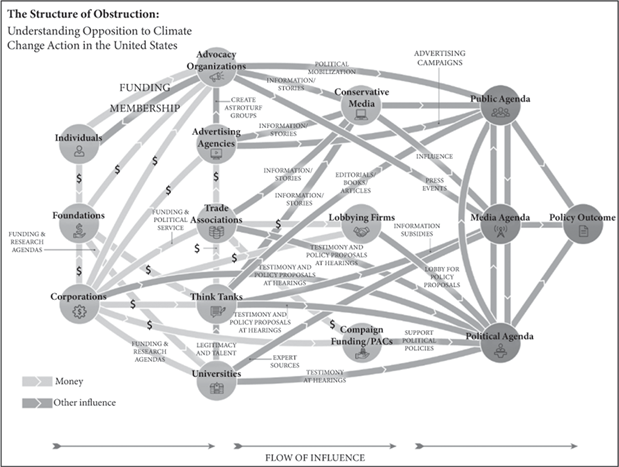
Figure 1: A network of climate obstruction actors and activities described by R. J. Brulle, “The Structure of Obstruction: Understanding Opposition to Climate Change Action in the United States,” CSSN Primer 2021 (https://cssn.org/wp-content/uploads/2021/04/CSSN-Briefing_-Obstruction-2.pdf).
The idea of resilience is therefore not only about responses to extrinsic shocks, but also to local efforts to mitigate for the causes of these shocks. In this context, the idea of resilience is curious. Our “system” appears strongly resilient, in that it is highly resistent to change, keeping our roads and our lungs clogged, rather than shift to healthier transportation. Our communities, on the other hand, seem rather vulnerable to division. Thus resilience takes different forms and Fernando et al., 2025 explore how three forms of community resilience relate to community sustaintability in the perceptions of a community in Ohio. They find that basic resilience, the abilty of a system to return to its original state, is probably in tension with sustainability (as we have seen with attempts to create healthier transport systems). However, adaptive resilience, whereby the community is able to continuously change and adapt, and transformative resilience*, whereby the community is reconfigured, have closer alignment to sustainability.
Social networks
Underlying how I am thinking about community cohesion is the importance of social networks to individuals and communities. It is accepted that networks and relationships are powerful influencers (the ISM tool provides a useful list of influences). For instance, Southampton’s Public Health Annual Report focussed on the importance of social connection for good health outcomes (Chase, 2025), describing activities that are underway to strengthen communities within the city. Community groups play a vital role in community resilience. Using interviews and network mapping, Morris et al., 2015 find that these groups’ ability to support people with long-term conditions is influenced by the ideology of the group, funding sources and purposes and the social network of these groups.
There is a huge body of work considering and understanding social networks, with a range of theories about the causes and effects of network structures (Gamper, 2022) and a large set of methods and objectives for their analysis (Tabassum et al., 2018). When it comes to resilience, social networks function by acting as the infrastructure and shaping the flow of community resources (Berkman, 2007). Considering a wide range of disasters in 6 studies, Liu & Mostafavi, 2025 observe that diffusion, inequality and the presence of critical nodes are common themes in studies of network dynamics and disaster resilience. In their review of 38 studies, Kessel et al., 2025 describe how both the abilities of communities (to anticipate, prevent, prepare and respond in a variety of ways) and the resources available to the community are key to the response to health emergencies. However, how the capacity of communities is developed is less well understood.
Less tangible entities also flow through social networks. Cardinal & Loughmiller-Cardinal, 2024 describe how the flow of information leads to the emergence of norms and then in Loughmiller-Cardinal & Cardinal 2023 find that norms are an “efficient system of communicating, filtering and preserving experiential information” and may be an “evolutionary adaptation of sociability itself”. Robertson et al., 2024 (see also https://www.theguardian.com/books/2025/jul/13/are-a-few-people-ruining-the-internet-for-the-rest-of-us) describe how extreme norms are more prevalant online than offline and this distorts people’s perceptions of what are society’s true norms.
Community buildling in practice
At a regular coffee morning recently, I enjoyed a conversation about building community from a practical perspective. One of the desirable assets that people identify about places they may choose to live is the sense or experience of community. Our commodification of housing seems to have led to a notion of being able to “buy into” a community. Almost, obviously, this is nonsense; Community is made. It struck me that there are accepted ideas that community is a binary (it is there or not there) and this sort of parallels the notion of “quality time” in parenting. I have come to the conclusion that “quality time” is a largely useless, as it creates expectations of turning up as our best selves (urgh). What matters is “quantity time” whereby we experience highs and lows of life together, bringing out and sharing our true selves. This is how trust is developed and strengthened.
This issue of time => trust applies to pretty much all human relationships doesn’t it? Cummins, 2025 emphasise how vital time (and space) are to building effective collaborations between communities, academics, policiymakers. Sadly, these three groups have very different needs, resources, schedules and capacities, something that I am committed to factoring into future work. Something that feels related, perhaps because of the overriding issue arising from our goal-obsessed culture, is a lovely article from Garcia, 2024. “The paradox of praxis” argues that our praxis should not focus on linear outcomes, or even mastery, but rather embrace the messiness of lived experience and consider our agency to be “iterative, relational and contingent”. This sounds to me like the application of systems-thinking: systems-doing.
With quantity time in mind, I have set out with a few neighbours to host an informal event on our tiny driveway to nurture stronger connections along our road. My biggest barrier for this is that first step of reaching out to strangers. I heard somewhere in a podcast that the only thing that people who joined the French Resistance had in common what that they were asked to join. I know how motivating being personally canvassed can be (a recent experiment in Southampton demostrated a small but important effect of door-to-door canvassing for recruiting into a citizens’ assembly: Tabero et al., unpublished). Therefore, the only right way to make community happen is to start knocking on doors. However, what was initially terrifying was quickly rewarded. It seemed like so many people were waiting for someone to step forward and ask for connection. Within a few short days we had created a street WhatsApp group and I’m delighted at the promises of cake and samosas.
Less visible impacts on community
Incidently, I am involved in research looking at what is already known and understood about the night time, particularly considering the effects of Artificial Light at Night (ALAN). This paper Ancillotti et al., 2025 provides an excellent overview of what is known and I was particularly struck by observation that “darkness fosters not only contemplation and reflection but also social bonding and shared experiences” - I wonder how much our social structures and behaviours have been dramatically shaped by our always-lit world?
References
Ancillotti, Mirko et al. (July 24, 2025). “Framing exposure to excessive and improper lighting as light-public health”. In: Discover Public Health 22 (1), p. 429. doi: 10.1186/s12982-025-00765-6
Berkman, L. F. (2007). “Social Networks and Social Isolation”. In: Encyclopedia of Stress. Ed. by George Fink. Second. Academic Press, pp. 523–527. doi: 10.1016/B978-012373947-6.00646-2
Cardinal, James Scott and Jennifer Ann Loughmiller-Cardinal (2024). “Information, Entanglement, and Emergent Social Norms: Searching for ‘Normal’”. In: Societies. doi: 10.3390/soc14110227
Chase, Debbie (Jan. 14, 2025). Southampton City: Taking a community-centred approach to health & wellbeing. Annual Report 2023/24. Public Health Annual Report. Southampton City Council. url: https://data.southampton.gov.uk/data-and-resources/needs-assessments/public-health-annual-reports/
Cummins, Ciaran (Nov. 26, 2025). Only as strong as the ground beneath us: Ensuring collaboration between academics, policymakers and communities can last. Yorkshire Policy Innovation Partnership (YPIP). url: https://ypip.org.uk/only-as-strong-as-the-ground-beneath-us-ensuring-collaboration-between-academics-policymakers-and-communities-can-last/
Dablander, Fabian et al. (Nov. 16, 2025). “Techno-optimistic scientists take fewer climate actions”. In: PsyArXiv. Version 1 of preprint. doi: 10.31234/osf.io/c3skb_v1
Fernando, Felix N., Meg Maloney, and Lauren Tappel (2025). “In the Face of Climate Change: Perceptions of Interconnections Between Community Resilience and Community Sustainability”. In: Urban Science 9.3. issn: 2413-8851. doi: 10.3390/urbansci9030060
Gamper, Markus (June 22, 2022). “Social Network Theories: An Overview”. In: Social Networks and Health Inequalities. Ed. by A. Kl”arner et al. Springer, pp. 35–48. doi: 10.1007/978-3-030-97722-1_3
Garcia, Sofia (Dec. 16, 2024). The Paradox of Praxis: Redefining Action and Agency in a Contradictory World. Intellectjinno. url: https://intellectjinni.com/the-paradox-of-praxis-redefining-action-and-agency-in-a-contradictory-world/ (visited on 03/01/2026)
Kessel, Gisela van et al. (Apr. 12, 2025). “Community resilience to health emergencies: a scoping review”. In: BMJ Global Health. doi: 10.1136/bmjgh-2024-016963
Liu, Chia-Fu and Ali Mostafavi (June 1, 2025). “Network dynamics of community resilience and recovery: new frontier in disaster research”. In: International Journal of Disaster Risk Reduction 123. doi: 10.1016/j.ijdrr.2025.105489
Loughmiller-Cardinal, Jennifer A. and James Scott Cardinal (2023). “The Behavior of Information: A Reconsideration of Social Norms”. In: Societies. doi: 10.3390/soc13050111
Morris, Rebecca et al. (June 2015). “Connecting local support: A qualitative study exploring the role of voluntary organisations in long-term condition management”. In: Chronic Illness 11.2. PMID: 25199957, pp. 140–155. doi: 10.1177/1742395314551098
Roberts, J. Timmons et al., eds. (Oct. 14, 2025). Climate Obstruction: A Global Assessment. doi: 10.1093/oso/9780197787144.001.000
Tabassum, Shazia et al. (Apr. 17, 2018). “Social network analysis: An overview”. In: WIREs Data Mining and Knowledge Discovery 8 (5), p. 21. doi: 10.1002/widm.1256
Tabero, K. et al. (unpublished). “Get Out to Deliberate (GOTD): Door-to-door Canvassing to Improve Civic Engagement”. Under review
Comments powered by Disqus.